The Epistemological Crisis: AI Codes Faster Than We Can Think
Anthropic's controlled study shows 17% comprehension decrease with AI assistance. Karpathy admits skill atrophy. Most developers use AI code they don't understand. The crisis isn't about AI quality—it's about knowledge management at AI speed.
TL;DR
Three developers ship what took twenty people six months. Then someone asks: “What changed in week one and why?” Silence. The code exists. It works. But the why is gone. Anthropic’s controlled study quantifies this: AI assistance reduces developer comprehension by 17% (n=52, Cohen’s d=0.738, p=0.01). The mechanism is cognitive offloading. The fix isn’t “document more”—it’s a new discipline: decision engineering, supported by session memory systems that preserve what AI-paced development destroys.
Quick Reference
THE CRISIS IN NUMBERS
─────────────────────
-17%    Comprehension decrease (Anthropic study)
 0.738  Effect size (large)
 80%    Of Karpathy's coding is agent-assisted
 50%    AI-assisted quiz score (vs 67% control)

WHAT GETS LOST
──────────────
• Alternatives tried and rejected
• Edge cases that shaped decisions
• Customer behavior assumptions
• Performance characteristics
• Failed approaches and why they failed

THE SIX PATTERNS (Anthropic)
────────────────────────────
BAD  (<40%):  Delegate | Progressive Reliance | AI Debug
GOOD (≥65%):  Gen-then-Comprehend | Hybrid | Conceptual

THE RULE
────────
"Can I explain WHY to a teammate?"
If no → you have code, not understanding.
Why This Matters
AI doesn’t just speed up coding. It breaks the mechanisms teams use to preserve context.
| Mechanism | Traditional | AI-Accelerated |
|---|---|---|
| Hallway conversations | ”Trying X, thoughts?“ | 3 features shipped before you walk over |
| Code reviews | 200-line PR, reviewer understands | 5,000-line PR, reviewer rubber-stamps |
| Standups | ”Implemented Y using Z" | "Shipped A through E” (nods) |
| Team meetings | Debate architecture | Feature shipped last Tuesday |
| Onboarding | 3-6 months, acceptable | Can’t wait when 3 do work of 20 |
The invisible handoff: developer describes requirement to AI. Agent makes 50 micro-decisions. Developer reviews output, looks good, ships. Those 50 decisions never surface to the team.
The Evidence
Anthropic Controlled Study: 17% Comprehension Decrease
Anthropic ran a randomized controlled trial with 52 junior-to-mid developers. Half got AI assistance, half coded manually on an unfamiliar library (Trio). Both groups took a comprehension quiz after.
| Metric | AI Group | Control | Delta |
|---|---|---|---|
| Quiz score | 50% | 67% | -17pp |
| Effect size | — | — | 0.738 (large) |
| Completion time | Slightly faster | Baseline | Not significant |
The speed gain wasn’t statistically significant. The comprehension loss was.
Six Interaction Patterns
The study identified six distinct patterns. Three preserve learning, three destroy it:
Patterns that destroy learning (<40% scores):
| Pattern | Behavior |
|---|---|
| AI Delegation | Completely hands off; fastest but learns nothing |
| Progressive Reliance | Starts independent, gradually delegates everything |
| Iterative AI Debugging | Uses AI to verify, never reasons about errors |
Patterns that preserve learning (≥65% scores):
| Pattern | Behavior |
|---|---|
| Generation-then-Comprehension | Gets code, then asks “why does this work?” |
| Hybrid Code-Explanation | Requests code + explanation simultaneously |
| Conceptual Inquiry | Asks conceptual questions, resolves errors independently |
Corroborating Evidence
| Source | Finding |
|---|---|
| Karpathy (2025) | Admits skill atrophy at 80% agent coding—from the architect of GPT |
| Clutch Survey (2025) | Most developers use AI-generated code they don’t understand |
| Microsoft/CHI (2025) | Knowledge workers self-report reduced cognitive effort with GenAI |
| WBUR/Renstrom (2026) | AI makes users overestimate their knowledge and performance |
The Three Universes Problem
When parallel AI agents make incompatible assumptions:
// Alice + AI Agent A
const amount: number = 1000;      // cents

// Bob + AI Agent B
const amount: number = 10.00;     // dollars

// Carol + AI Agent C
const amount: string = "10.00 USD"; // string

// Integration day
const total = alice.amount + bob.amount + carol.amount;
// Result: "101010.00 USD" 🔥
Each decision was locally reasonable. AI suggested it. Developer approved it. No coordination mechanism existed.
Why the Old Answers Fail
| Old Answer | Why It Fails at AI Pace |
|---|---|
| ”Takes time to learn the codebase” | Can’t wait 6 months when 3 people do work of 20 |
| ”Just read the code” | Code shows WHAT, not WHY. AI code is even less self-documenting |
| ”Ask Sarah, she knows” | Sarah made 50 AI-agent decisions—can’t remember which were deliberate |
| ”Document it later" | "Later” never comes. Even if it does, you don’t remember the reasoning |
Decision Engineering: The New Core Discipline
The bottleneck shifted from implementation to decision clarity.
BEFORE                          AFTER
──────                          ─────
Bottleneck: Implementation      Bottleneck: Decision clarity
Skill: "Can you code this?"     Skill: "Can you specify this?"
Output: Lines of code           Output: Clear decisions
Failure: Slow delivery          Failure: Wrong decisions at speed
The Skill Stack
| Level | Skill | Example |
|---|---|---|
| L1 | Specification | ”Add auth with JWT, 24h expiry, refresh tokens” |
| L2 | Decision documentation | ”JWT over sessions: stateless scaling, mobile support” |
| L3 | Alternative analysis | ”JWT vs sessions vs OAuth: compared on latency, complexity, security” |
| L4 | Trade-off quantification | ”JWT adds 2KB/request but eliminates session store ($200/mo saved)“ |
| L5 | Context curation | Provide the right spec + constraints to AI agent |
The Mitigation Stack
Three layers address different aspects:
| Layer | When | Tools | What It Preserves |
|---|---|---|---|
| During session | Proactive | GCC memory, Entire capture, Plan mode | Agent decisions as they happen |
| After session | Retroactive | Tacit Session Map, AI-generated ADRs | Extracted meaning with confidence |
| Across sessions | Persistent | Cross-session search, CLAUDE.md | Institutional knowledge |
How the Ecosystem Fits
DURING SESSION              AFTER SESSION
──────────────              ─────────────
GCC structures              Tacit extracts
Entire captures             ADRs document
Plan mode specifies         Commits explain
        │                           │
        └──────────┬────────────────┘
                   │
           ACROSS SESSIONS
           ───────────────
           Cross-session search
           CLAUDE.md evolution
           Session-aware onboarding
The Practical Rule
After every AI-generated code block, ask:
“Can I explain to a teammate why this approach was chosen over alternatives?”
If the answer is no, you have code but not understanding. Ask the AI to explain before moving on. This single practice maps to the “Generation-then-Comprehension” pattern—one of the three that preserve learning.
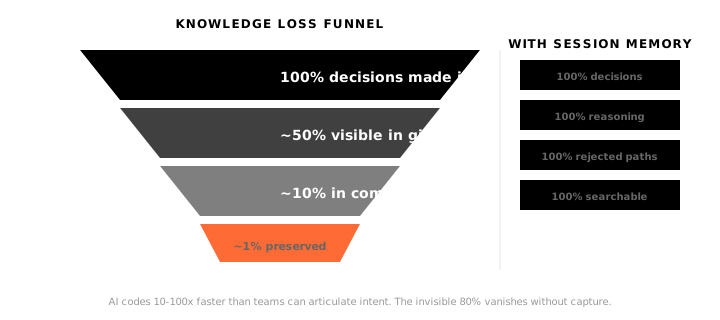
What Gets Lost (The Invisible 80%)
| Category | Example | Cost of Losing It |
|---|---|---|
| Alternatives rejected | ”Tried sync, polling, chose webhooks” | Future devs retry failed approaches |
| Edge cases | ”Double-click charged twice with MongoDB v3.6” | Hit same bug in production |
| Customer behavior | ”Users hammer Save—500ms debounce reduces 97%“ | Remove debounce, crash server |
| Performance data | ”5-min cache = 92% hits; 10-min = stale data complaints” | Suboptimal defaults |
| Failed approaches | ”WebSockets killed mobile battery” | Repeat the experiment |
The Forcing Function
The epistemological crisis isn’t a bug. It’s a forcing function.
AI acceleration exposes what teams always needed but could avoid:
- Explicit decision-making
- Preserved rationale
- Documented alternatives
- Quantified trade-offs
- Shared context
We got away with implicit knowledge because we moved slowly, stayed small, and accepted waste. We can’t anymore.
The teams that adapt operate in a categorically different way: knowledge accumulates instead of evaporating, context scales instead of fragmenting, understanding deepens instead of decaying.
Open Questions
- What’s the actual cost of an integration catastrophe? Anecdotal evidence but no measurement
- Does session memory reduce re-learning? The Tacit thesis—needs controlled experiment
- Do AI-generated ADRs capture real rationale? Or just plausible-sounding summaries?
- Is the 17% decrease the floor? Anthropic’s study was short-term; long-term effects may be worse
Sources & Provenance
Verifiable sources. Dates matter. Credibility assessed.
How AI Assistance Impacts the Formation of Coding Skills ↗
Anthropic Research · Anthropic / arXiv 2601.20245
"Randomized controlled trial with 52 developers: AI assistance reduces comprehension by 17% (d=0.738, p=0.01). Identifies six interaction patterns—three preserve learning (ask conceptual questions), three destroy it (delegate everything)."
The Impact of Generative AI on Critical Thinking (CHI 2025) ↗
Microsoft Research · CHI 2025
"Knowledge workers self-report reduced cognitive effort when using GenAI. Higher trust in AI correlates with less critical thinking. Cognitive offloading mechanism confirmed."
Blind Trust in AI: Most Devs Use AI-Generated Code They Don't Understand ↗
Clutch · Clutch Survey
"Industry survey confirms majority of developers ship AI-generated code without full comprehension. Pattern matches Anthropic's 'AI Delegation' interaction style."
AI Makes Us Overestimate Our Knowledge ↗
Joelle Renstrom · WBUR Cognoscenti
"AI amplifies the Dunning-Kruger effect: users overestimate their performance regardless of skill level. Developers may not realize what understanding they've lost."
Avoiding Skill Atrophy in the Age of AI ↗
Addy Osmani · Substack
"Google Chrome engineer's practical mitigation strategies. Recommends deliberate practice alongside AI use, understanding before accepting, and periodic manual coding."
When Should I Write an Architecture Decision Record ↗
Spotify Engineering · Spotify Engineering Blog
"Foundational ADR practice guide. Write ADRs for multi-team decisions, hard-to-reverse choices, and trade-off decisions. Pre-AI baseline for decision documentation."
Building an Architecture Decision Record Writer Agent ↗
Piethein Strengholt · Medium
"Multi-agent ADR generation from codebases. Scanner → Writer → Reviewer pipeline. Captures WHAT was decided but struggles with WHY—the most valuable part."
The Epistemological Crisis: When AI Codes Faster Than We Can Think ↗
Internal Draft · Planned Blog Post
"Original thesis: AI generates code 10-100x faster than teams can articulate intent. Breaks osmosis-based knowledge transfer. Introduces 'decision engineering' as new core discipline."