The AI Coding Phase Shift: A Multi-Perspective Analysis
When the architect of GPT and Tesla Autopilot says AI is changing how he codes—and degrading his skills—four expert perspectives examine what this means for the rest of us.
TL;DR
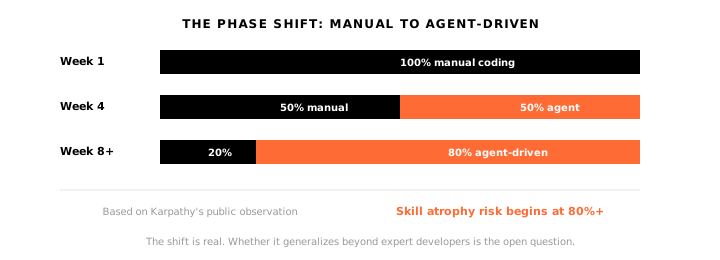
Andrej Karpathy—OpenAI founding member, former Tesla AI Director, architect of systems that power modern AI—documented a phase shift: 80% agent coding, skill atrophy beginning, a “slopacolypse” incoming. This isn’t hype from an observer. It’s field notes from someone who built the tools, now watching them change how even he works. Four expert perspectives examine the implications.
Why This Source Matters
Before the analysis, context: Karpathy isn’t a user reviewing a product. He helped create GPT. He built Tesla’s Autopilot neural networks. His Stanford course (CS231n) trained a generation of ML engineers. When he says agents make “subtle conceptual errors like hasty junior devs,” he’s comparing them to systems he designed. When he admits his manual coding skills are atrophying, it’s someone who could rebuild these models from scratch acknowledging an irreversible shift.
This changes how the panel reads every observation.
What Karpathy Observed
| Theme | Observation | Panel Note |
|---|---|---|
| Workflow Flip | 80% manual → 80% agent coding in weeks | If the architect adopts this fast, the tradeoff is real |
| IDE Still Necessary | Models make subtle conceptual errors like “hasty junior devs” | He catches these because he built them. Can you? |
| Common Failures | Wrong assumptions, no clarifications, overcomplicated code, bloated abstractions | Design confession from the designer |
| Tenacity | Agents never tire. “Feel the AGI” watching 30-min struggles succeed | Expensive compute—but he finds it worthwhile |
| Speedup vs Expansion | Not faster—doing things that weren’t worth coding before | The real unlock isn’t velocity; it’s scope |
| Leverage | Declarative > Imperative. Tests first, then pass them | TDD from someone who understands test design |
| Fun Factor | Drudgery removed, creative part remains. More courage. | Selection bias acknowledged |
| Atrophy | Manual coding ability already degrading | The buried lede—from someone with massive baseline |
| Slopacolypse | Brace for AI slop across GitHub, arXiv, social media | Insider extrapolation, not speculation |
His Open Questions
- Does the 10X engineer ratio grow with LLMs?
- Do generalists outperform specialists now?
- What’s the future feel? StarCraft? Factorio? Music?
- How much of society is bottlenecked by digital knowledge work?
The Panel
| Persona | Lens | Key Question |
|---|---|---|
| The Quality Auditor | Brutal scoring, no mercy | What’s the actual quality here? |
| The Veteran Engineer | 18 years of patterns failing | How does this generalize beyond Karpathy? |
| The Clarity Editor | Compression, anti-jargon | What is he really saying? |
| The Craft Council | Masters of the discipline | What happens to the craft? |
The Quality Auditor
Score: 8.5/10 — “Reluctantly excellent”
This is an architect critiquing his own cathedral. When Karpathy says agents have flaws, it’s a design confession. When he uses them 80% anyway, it’s not hypocrisy—it’s an honest assessment that the tradeoffs work for someone at his level.
My concern has shifted. The question isn’t “is Karpathy wrong?” He’s clearly not. The question is: if Karpathy, with his baseline, still finds atrophy worth accepting, what chance does anyone else have of maintaining discipline?
His “slopacolypse” prediction is credible because he can model the capability curves from the inside. He’s not guessing. He’s extrapolating.
Recalibrated Concerns
| Observation | Typical Reading | Karpathy-Informed Reading |
|---|---|---|
| 30-min agent struggles | Inefficient | He knows compute cost better than anyone—still worthwhile |
| 80% adoption despite flaws | Reckless | Signal: tradeoffs are real and accepted at expert level |
| Atrophy admission | Concerning | Alarming—if his skills degrade, everyone’s will faster |
| Slopacolypse warning | Speculation | High-confidence insider extrapolation |
The Veteran Engineer
“I’ve seen this pattern fail—but never from someone who built the pattern”
Normally I translate hype to reality. Karpathy is reality here. He built the neural networks. Shipped Autopilot. His translations don’t need my corrections—they need my caveats:
- “80% agent coding” → 80% of Karpathy’s codebase. He can debug it. Can you?
- “Programming in English” → Works when your mental model is correct. His is. Yours might not be.
- “Bloated abstractions” → He catches and fixes them. Most engineers will ship them.
- “Watch them like a hawk” → His hawk has 20 years of training. New hawks are blind.
The gap between Karpathy’s experience and everyone else’s is the real story. He’s describing a workflow that works for someone with his foundation. Generalizing it is the danger.
The Practical Fix
If Karpathy—with decades of systems thinking—still needs constant vigilance, the rest of the industry needs guardrails, not workflows.
| Pattern | Application |
|---|---|
| Agents for | Boilerplate, tests, migrations, leaf nodes |
| Humans for | Interfaces, contracts, architecture, anything shared |
| Explicit boundaries | Not vigilance—actual rules |
The Clarity Editor
“Say what you mean, simply”
My job is to strip jargon. Karpathy’s post is already unusually honest for someone of his stature—no corporate hedging, no academic obscurity. He’s documenting costs most AI leaders deny.
Compressed:
- AI writes most of my code now
- It makes mistakes I catch
- My manual skills are degrading
- This works for me, but I’m worried about the industry
The honesty is the story. Most leaders sell the upside. Karpathy is publishing a real-time field report including the downsides—atrophy, errors, coming flood of slop.
“Slopacolypse” isn’t hyperbole. It’s a prediction from someone who can model the curves. When Karpathy warns, take notes.
The Craft Council
Representing: TDD Master, Refactoring Expert, Design Principles Guide, Simplicity Advocate, Systems Maintainer
Preamble: Karpathy’s CS231n course shaped how many of us think about neural systems. His observations carry unusual weight—he’s critiquing tools he helped create.
On “Tests first, then pass them”
TDD. Good. Karpathy knows TDD at scale. But TDD requires understanding what to test. His test designs are informed by decades of intuition. Agents writing tests that pass isn’t the same as agents writing good tests.
The leverage only works within competence boundaries.
On “1000 lines cut to 100”
Karpathy caught this. Pushed back. Agent complied. The Council asks: how many engineers have his pattern recognition? This workflow requires expertise. Without it, the 1000 lines ship.
On “Don’t surface tradeoffs”
This is the most damning observation. Simple systems require choices. Agents don’t make choices—they make output. Karpathy compensates with judgment. But judgment atrophies without practice.
On “Agent swarm hype is too much”
Appreciated restraint. But we note: Karpathy can resist hype because his fundamentals are solid. The industry will copy his 80% adoption rate without his discrimination ability. Everyone gets the workflow; few get the foundation.
The Core Debates
Debate 1: The Atrophy Problem
| Perspective | Position |
|---|---|
| Quality Auditor | If Karpathy experiences atrophy, this is an industry emergency. His baseline is exceptional—his atrophy still leaves him more capable than most engineers at peak. Everyone else is starting lower and falling faster. |
| Veteran Engineer | Karpathy has 20+ years of neural network intuition to coast on. New engineers have nothing. Veterans degrade slowly from high baseline; juniors never build the baseline at all. |
| Clarity Editor | Most leaders deny atrophy. Karpathy documenting it about himself, in real-time, makes it undeniable. The honesty is the signal. |
| Craft Council | If Karpathy—with his discipline—isn’t maintaining manual skills, the industry won’t either. The question answers itself. |
Verdict: Karpathy’s experience is the best case. Everyone else will fare worse.
Debate 2: The 10X Engineer Question
| Perspective | Position |
|---|---|
| Quality Auditor | Karpathy is already 100X. With agents, potentially 1000X. But the gap isn’t 10X anymore—it’s 100X+. The ceiling disappears; the floor stays fixed. |
| Veteran Engineer | Karpathy’s question “what happens to the 10X engineer” reveals he’s thinking about this. His implicit answer: the ratio explodes. A few become demigods; most become prompt operators. |
| Clarity Editor | Karpathy is the 10X engineer he’s asking about. His observations are the answer: experts leverage massively; everyone else gets modest boost with hidden costs. |
| Craft Council | Karpathy with agents is existence proof of extreme leverage. But the path to becoming Karpathy may be closing as juniors learn via prompts instead of fundamentals. |
Verdict: The multiplier is real and asymmetric. The path to earning it may be closing.
Debate 3: Generalists vs Specialists
| Perspective | Position |
|---|---|
| Quality Auditor | Karpathy’s observation that “LLMs are better at micro than macro” is him saying exactly what matters: macro understanding is the moat. He has it. Most don’t. |
| Veteran Engineer | Karpathy’s career (academia → OpenAI → Tesla → education) shows the pattern: deep expertise that transfers. Agents amplify people who understand principles, not practices. |
| Clarity Editor | The dichotomy is false at Karpathy’s level. He’s deep enough to understand, broad enough to apply. For everyone else: pick one type of depth while agents handle micro. |
| Craft Council | Karpathy understands why (PhD), where (industry), and what (decades of coding). He’s the full stack. Agents help him skip boring parts. For others, agents paper over gaps that eventually collapse. |
Verdict: The question isn’t generalist vs specialist. It’s depth of understanding. Karpathy has both; most must choose.
What’s True, What’s Overstated, What’s Missing
What’s True
| Finding | Confidence |
|---|---|
| December 2025 marked a capability threshold | High |
| Workflow changes are real and rapid | High |
| Agents make subtle conceptual errors | High (confirmed by architect) |
| Atrophy has begun | High (self-reported by expert) |
| Review burden is increasing | High |
What’s Overstated
| Claim | Reality |
|---|---|
| ”Programming in English” | Works when mental model is correct. Karpathy’s is. Most people’s aren’t. |
| ”Feel the AGI moments” | Expensive compute that Karpathy can justify. Others should be more critical. |
| ”More fun” | For Karpathy, who keeps the creative parts. For juniors, they might never learn what was removed. |
What’s Missing
| Gap | Why It Matters |
|---|---|
| Quality metrics | Karpathy doesn’t share defect rates, security issues, maintainability data |
| Longitudinal view | Observations are weeks old |
| Team dynamics | Individual workflow ≠ organizational workflow |
| Economic analysis | What does 10x code at 0.5x quality cost? |
| Path to expertise | How do juniors develop Karpathy-level judgment in an agent-first world? |
Implications By Role
For Individual Engineers
| If you’re… | Then… |
|---|---|
| Senior/Expert | Karpathy’s workflow may work for you. Monitor your own atrophy. |
| Mid-level | Build fundamentals deliberately. Agent adoption without foundation is debt. |
| Junior | You face the hardest challenge: learning craft while tools hide it. Resist full adoption. |
For Engineering Managers
- Quality metrics need updating — Velocity without quality is negative productivity
- Review capacity is now a bottleneck — More code, same reviewers
- Team composition shifts — Fewer generators, more architects and reviewers
- Junior development changes — How do you grow juniors who never write manual code?
For Product Leaders
- Scope expansion is real — Teams can attempt previously impossible things
- Quality variance increases — Best teams get better; worst teams get worse faster
- Time-to-prototype drops — But time-to-production-quality doesn’t
- Due diligence matters more — Can the team maintain what they shipped?
For Organizations
- Training investments change — Less syntax, more design and systems thinking
- Hiring criteria shift — Coding tests matter less; design conversations matter more
- Architecture investment increases — Good foundations leverage agents better
- Technical leadership premium grows — People who truly understand become rarer
The Bottom Line
Quality Auditor’s Final Score: 8.5/10
An architect critiquing his own creation, documenting costs in real-time, warning about risks he’s experiencing personally—this is intellectual honesty at the highest level. Karpathy’s observations are credible because of who’s making them.
Veteran Engineer’s Prescription
| Audience | Prescription |
|---|---|
| Karpathy-tier engineers | Your workflow works because of your foundation. Don’t generalize it. |
| Everyone else | Cap agent usage at 40% for shared code. Maintain manual skills deliberately. |
| Organizations | Never let agents touch architecture. Review agent code with more scrutiny. |
| The industry | Karpathy’s atrophy is our early warning. Heed it. |
Clarity Editor’s Rewrite
“One of the architects of modern AI says it’s changing everything—including degrading his own skills. He’s worried about the rest of us. We should be too.”
Craft Council’s Consensus
The phase shift is real. Karpathy documents it with unusual honesty. The discipline to survive it is rare—and Karpathy himself isn’t sure he has it. Most engineers will become prompt operators. A few will remain engineers. The path between them may be closing.
Key Takeaways
| For | Takeaway |
|---|---|
| Engineers | If Karpathy’s skills atrophy, yours will faster. Protect them deliberately. |
| Managers | Measure quality, not velocity. The metrics that worked before mislead now. |
| Product | Scope expansion is the opportunity. Quality variance is the risk. |
| Organizations | Invest in architecture and review capacity. They’re the new bottlenecks. |
Aside: About The Source
Andrej Karpathy’s credentials inform every observation in this analysis:
| Role | Significance |
|---|---|
| OpenAI Founding Member | Helped create GPT. Not observer—creator. |
| Tesla AI Director (2017-2022) | Built Autopilot neural networks. Shipped AI at scale. |
| Stanford PhD, CS231n Creator | Academic depth; his course trained a generation of ML engineers. |
| 2.2M+ followers | One of the most influential voices in AI. |
When Karpathy writes about AI coding, he’s critiquing tools he helped build. When he admits atrophy, it’s someone who could rebuild these models from scratch. This isn’t commentary—it’s field notes from an architect.
Sources & Provenance
Verifiable sources. Dates matter. Credibility assessed.
A few random notes from claude coding quite a bit last few weeks ↗
Andrej Karpathy · X (Twitter)
"First-hand observations on the December 2025 phase shift in AI-assisted software development: 80% agent coding, workflow transformation, atrophy concerns, and the coming slopacolypse."