Git Context Controller: Version-Controlled Memory for LLM Agents
An Oxford paper treats agent memory like Git—commit, branch, merge, context. Achieves 48% on SWE-Bench-Lite, outperforming 26 systems. We contextualize the findings against Tacit's session intelligence and what this means for persistent agent memory.
TL;DR
Junde Wu (Oxford) introduces Git Context Controller (GCC)—a framework that structures agent memory as a version-controlled file system with four explicit operations: COMMIT, BRANCH, MERGE, CONTEXT. On SWE-Bench-Lite, GCC achieves 48% resolution (144/300 tasks), outperforming 26 competing systems including Claude variants and GPT-4o. The key insight: memory scaffolding, not model capability, is the bottleneck for autonomous agents. This has direct implications for how session intelligence systems like Tacit’s Session Map should evolve.
Research Brief
Mission: Understand the GCC paper’s approach to agent memory as version-controlled context, evaluate its evidence, and contextualize against Tacit’s existing session intelligence extraction.
Decision: How should persistent session memory systems be architected? Does the version-control metaphor hold?
Scope: Covers the paper’s methodology, results, and emergent behaviors. Excludes reimplementation details.
Source Assessment
| Source | Type | Credibility | Notes |
|---|---|---|---|
| GCC Paper (arXiv 2508.00031) | Academic | High | Primary source, Oxford, SWE-Bench results |
| GCC Repository | Code | High | Working implementation, reproducible |
| EmergentMind Analysis | Practitioner | Medium | Useful synthesis, no original research |
| Medium Analysis (Balaji) | Practitioner | Medium | Good contextual framing |
The Core Problem
Current agent memory approaches fail for long-horizon tasks:
| Approach | Problem |
|---|---|
| Full context | Hits token limits, quality degrades (“Lost in the Middle”) |
| Sliding window | Loses critical early context (variable definitions, decisions) |
| Summarization | Loses concrete detail, risks “context poisoning” from hallucinated summaries |
| System prompt | Requires “re-teaching” the model every session |
GCC’s thesis: treat agent memory like a file system with explicit operations, not a passive token stream.
How GCC Works
The .GCC/ Directory Structure
.GCC/
├── main.md                    # Global roadmap (shared across branches)
└── branches/
    └── main/
        ├── commit.md          # Structured progress summaries
        ├── log.md             # Fine-grained Observation-Thought-Action traces
        └── metadata.yaml      # File structures, dependencies, interfaces
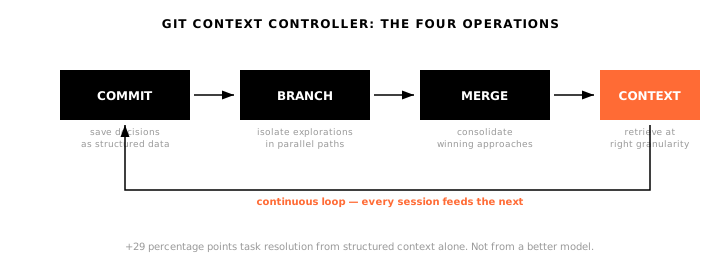
Four Commands
| Command | What It Does | Git Analog |
|---|---|---|
| COMMIT | Checkpoints meaningful milestones, updates commit.md, optionally revises roadmap | git commit |
| BRANCH | Creates isolated exploration space for alternative approaches | git branch + git checkout |
| MERGE | Synthesizes completed branches back to main with origin tracing | git merge |
| CONTEXT | Retrieves memory at varying granularities—high-level plans to low-level OTA steps | git log + git show |
Multi-Level Memory Architecture
┌──────────────────────────────────────────────┐
│  main.md          High-level roadmap         │
│  (Strategic)      Goals, milestones          │
├──────────────────────────────────────────────┤
│  commit.md        Progress checkpoints       │
│  (Tactical)       What was done and why      │
├──────────────────────────────────────────────┤
│  log.md           Fine-grained OTA traces    │
│  (Operational)    Observation-Thought-Action  │
├──────────────────────────────────────────────┤
│  metadata.yaml    Technical details          │
│  (Reference)      Files, deps, interfaces    │
└──────────────────────────────────────────────┘
The CONTEXT command retrieves from the appropriate level: strategic overview for planning, operational detail for debugging.
Evidence: SWE-Bench-Lite Results
| Metric | GCC | Next Best (CodeStory Aide) |
|---|---|---|
| Tasks Resolved | 48.00% (144/300) | 43.00% |
| Line-level Localization | 44.3% | — |
| Function-level Localization | 61.7% | — |
| File-level Localization | 78.7% | — |
| Average Cost | $2.77/task | — |
| Average Tokens | 569,468 | — |
Outperformed 26 competing systems including GPT-4o variants, Claude variants, and commercial tools.
Self-Replication Case Study
The strongest evidence: Claude Code CLI reproducing itself from scratch.
| Setup | Resolution Rate |
|---|---|
| Original CLI | 72.7% |
| Reproduced CLI without GCC | 11.7% |
| Reproduced CLI with GCC | 40.7% |
That’s a 29-percentage-point improvement from memory scaffolding alone. Same model, same task. The scaffolding is doing the heavy lifting.
Emergent Behaviors (The Buried Lede)
The most interesting findings aren’t in the benchmarks—they’re in the unexpected behaviors:
1. Spontaneous Modularization
Without explicit instruction, the agent:
- Recognized limitations of transient output
- Proposed persistent file I/O abstraction
- Implemented
write_file(path, content)utility - Created tests before committing
- Treated commits as architecturally complete units
“The agent behaved like a modular system architect.”
2. Autonomous Branching for Exploration
The agent independently:
- Created a
RAG-memorybranch to prototype vector-indexed OTA records - Tested semantic retrieval on SWE-Bench
- Documented performance tradeoffs (fragility, compute cost)
- Abandoned the approach based on empirical evidence
- Reverted to mainline memory system
This is hypothesis-driven exploration emerging from structural affordances. The agent didn’t just follow instructions—it ran experiments and changed direction based on results.
Contextualization: GCC vs Tacit Session Map
Tacit’s Session Map extracts 5-column intelligence from Claude sessions: Intent, Context, Decisions, Blockers, Outcomes. How does GCC relate?
Alignment Map
| GCC Component | Tacit Session Map Equivalent | Overlap |
|---|---|---|
main.md (roadmap) | Intent (primary/secondary objectives) | High |
commit.md (progress) | Outcomes (files created/modified) + Decisions | Partial |
log.md (OTA traces) | Bill of Materials (tool calls, commands, reasoning) | High |
metadata.yaml (deps) | Context (files explored, docs fetched) | Medium |
| BRANCH/MERGE | No equivalent (sessions are linear) | None |
| CONTEXT retrieval | Phase 1 + Phase 2 extraction pipeline | Conceptual |
What GCC Has That Tacit Doesn’t
| Capability | Why It Matters |
|---|---|
| Branching | Agents can explore alternatives without corrupting main trajectory |
| Multi-level retrieval | Strategic vs operational context on demand |
| Agent-authored commits | Memory structured by the agent during work, not extracted after |
| Cross-session persistence | Memory survives context window resets natively |
What Tacit Has That GCC Doesn’t
| Capability | Why It Matters |
|---|---|
| Post-hoc intelligence | Extracts meaning from sessions that weren’t instrumented |
| Blocker tracking | Explicit error/debug cycle detection with resolution status |
| Handoff generation | Ready-to-paste continuation prompts |
| Human-readable narratives | File narratives, phase descriptions for team consumption |
| Decision confidence levels | Distinguishes explicit user decisions from inferred ones |
| Cost tracking | Per-session extraction cost awareness |
The Key Difference
GCC is proactive—the agent structures its own memory during work. Tacit is retroactive—intelligence is extracted from completed sessions.
These are complementary, not competing:
DURING SESSION              AFTER SESSION
─────────────               ─────────────
GCC structures              Tacit Session Map
memory as agent             extracts intelligence
works (proactive)           from transcript
                            (retroactive)
        │                           │
        └─────────┬─────────────────┘
                  │
          COMBINED VALUE
          ─────────────
          Agent-authored commits
          + AI-extracted decisions
          + Human-readable narratives
          + Cross-session search
Gold Seams: What’s Worth Going Deep On
Must Understand
| Seam | Why Critical | Tacit Relevance |
|---|---|---|
| Commit-as-checkpoint | Agents choosing when to checkpoint creates natural summarization boundaries | Session Map could detect “natural commit points” in sessions |
| Multi-level retrieval | Strategic vs operational memory prevents Lost-in-the-Middle | Handoff generation could offer summary vs detail modes |
| Emergent modularization | Structural affordances drive architectural behavior | Session Map phases could inform when agents “level up” |
Must Avoid
| Pitfall | Evidence | Mitigation |
|---|---|---|
| Over-structuring | GCC adds $2.77/task overhead | Only structure what will be retrieved |
| Schema rigidity | metadata.yaml format may not generalize | Keep schemas flexible, evolve with usage |
| Branching overuse | Linear tasks don’t need branching | Detect task complexity before offering branches |
Must Experiment
| Unknown | How to Test |
|---|---|
| Does proactive + retroactive memory outperform either alone? | Run GCC-instrumented sessions through Tacit extraction |
| What commit granularity maximizes retrieval quality? | Vary commit frequency, measure downstream task accuracy |
| Can Session Map phases approximate GCC branches? | Compare phase-detected exploration with explicit branches |
Implications for Tacit
Near-Term (Session Map Enhancement)
-
Natural commit detection: Identify points in sessions where the agent made meaningful progress (analogous to GCC commits). Use phase boundaries + outcome detection.
-
Multi-level handoff: Currently handoff is one level. Could offer:
- Strategic: Intent + decisions (for new team member)
- Tactical: Outcomes + blockers (for session continuation)
- Operational: Full BOM + file narratives (for debugging)
-
Branch detection: Sessions where the user says “actually, let’s try X instead” represent implicit branches. Track these as decision forks with outcomes.
Medium-Term (Proactive Memory)
-
Session-aware CLAUDE.md: Use extracted decisions across sessions to auto-suggest CLAUDE.md rules. If the same decision appears 3+ times, it’s a pattern worth codifying.
-
Cross-session retrieval: GCC’s CONTEXT command retrieves from prior work. Tacit could offer “relevant prior sessions” when starting new work in the same codebase.
Long-Term (Convergence)
- Bidirectional intelligence: Agent structures memory (GCC-style) during session, Tacit enriches it post-session with human-readable narratives, confidence scoring, and cross-session linking.
Industry Signal: Entire Checkpoints ($60M Seed)
Two days ago (Feb 10, 2026), former GitHub CEO Thomas Dohmke launched Entire with a $60M seed round at $300M valuation—the largest seed raise for a dev tools startup ever. Their first product: Checkpoints, an open-source CLI that captures AI coding sessions and links them to Git commits.
This validates the thesis that agent session memory is a real market, not just a research interest.
What Entire Checkpoints Does
| Aspect | Detail |
|---|---|
| Core function | Captures prompts, reasoning, decisions, and constraints from AI agent sessions |
| Storage | Structured, versioned data on a separate entire/checkpoints/v1 Git branch |
| Trigger | Git hooks installed via entire enable—captures on commit or after each agent response |
| Agents supported | Claude Code, Gemini CLI (Codex, Cursor CLI planned) |
| Key commands | enable, disable, status, rewind, resume, explain |
How It Relates to GCC and Tacit
| Dimension | GCC (Academic) | Entire Checkpoints (Product) | Tacit Session Map (Product) |
|---|---|---|---|
| Memory model | File system with 4 commands | Git branch with checkpoints | 5-column intelligence extraction |
| When it captures | Agent-directed (proactive) | Hook-triggered (automatic) | Post-session (retroactive) |
| Granularity | Strategic/tactical/operational levels | Per-commit or per-response snapshots | Intent, context, decisions, blockers, outcomes |
| Branching | Explicit BRANCH/MERGE | Worktree-aware, per-branch tracking | No equivalent (linear sessions) |
| Intelligence | Raw memory (agent navigates) | Raw capture (developer navigates) | AI-extracted meaning with confidence |
| Human readability | Low (agent-formatted) | Medium (structured transcripts) | High (narratives, handoff prompts) |
| Open source | Yes | Yes | Proprietary |
The Key Insight
Entire captures what happened. Tacit extracts what it means. GCC lets the agent structure as it goes.
ENTIRE                 GCC                    TACIT
──────                 ───                    ─────
Records sessions       Agent structures       Extracts intelligence
on Git commits         its own memory         from transcripts

"What happened"        "What I'm doing"       "What it means"
(capture)              (structure)            (analysis)
Three layers of the same problem. Entire is the capture layer. GCC is the agent-side structure layer. Tacit is the intelligence layer.
Competitive Implications
| Signal | Meaning for Tacit |
|---|---|
| $60M seed at $300M | Market is real and large—session memory is a category |
| GitHub CEO building this | Incumbents see the gap too; validation of the thesis |
| Open-source CLI first | Land with developers, expand with platform—same playbook |
| Raw capture, no intelligence | Entire captures but doesn’t analyze—Tacit’s differentiation |
| Git-native storage | Clean engineering; but Git branches aren’t queryable—Tacit’s structured DB is |
The Numbers That Matter
| Metric | Value | Significance |
|---|---|---|
| Memory scaffolding improvement | +29pp (11.7% → 40.7%) | Scaffolding > model capability for long tasks |
| SWE-Bench resolution | 48% (vs 43% next best) | State-of-the-art with structure, not scale |
| Cost per task | $2.77 | Acceptable overhead for 5pp improvement |
| Tokens per task | 569K | ~3x a single context window |
Quick Reference
GCC MENTAL MODEL
────────────────
COMMIT  = "Save meaningful progress"
BRANCH  = "Explore alternative safely"
MERGE   = "Bring exploration back"
CONTEXT = "Retrieve what I need at right granularity"

KEY INSIGHT
───────────
Memory scaffolding > model capability
Structure during work > extraction after work
Both together > either alone

TACIT INTEGRATION OPPORTUNITIES
───────────────────────────────
1. Detect natural commit points in sessions
2. Multi-level handoff (strategic/tactical/operational)
3. Branch detection from decision forks
4. Cross-session retrieval ("relevant prior sessions")
5. Auto-suggest CLAUDE.md rules from repeated decisions
Open Questions
- Generalization beyond SWE-Bench: Does GCC work for non-coding tasks (research, writing, analysis)?
- Human-in-the-loop commits: Should users approve agent commits, or is autonomous better?
- Memory decay: GCC keeps everything—should older branches/commits be compacted?
- Multi-agent GCC: Can multiple agents share a
.GCC/directory effectively?
Sources & Provenance
Verifiable sources. Dates matter. Credibility assessed.
Git Context Controller: Manage the Context of LLM-based Agents like Git ↗
Junde Wu · arXiv (University of Oxford)
"Structures agent memory as version-controlled file system with COMMIT, BRANCH, MERGE, CONTEXT. Achieves 48% on SWE-Bench-Lite, outperforming 26 systems. Self-replication shows +29pp from scaffolding alone."
GCC: Git Context Controller Repository ↗
Junde Wu / World of Agents · GitHub
"Working implementation of the .GCC/ directory structure with four core commands. Includes SWE-Bench evaluation scripts and self-replication case study code."
Git-Context-Controller Topic Analysis ↗
EmergentMind · EmergentMind
"Contextualizes GCC within broader agent memory landscape. Notes the shift from passive token management to active memory structuring as key innovation."
From Token Streams to Version Control: Git-Style Context Management for AI Agents ↗
Balaji Bal · Medium
"Practitioner synthesis of GCC paper. Highlights emergent modularization and autonomous branching as evidence that structural affordances drive agent behavior."
Entire Checkpoints CLI ↗
Entire (Thomas Dohmke) · GitHub
"Open-source CLI capturing AI agent sessions as structured, versioned data linked to Git commits. Supports Claude Code and Gemini CLI. Stores on separate checkpoint branch, supports rewind and resume."
Hello Entire World ↗
Thomas Dohmke · Entire Blog
"Former GitHub CEO launches Entire with $60M seed at $300M valuation. First product Checkpoints captures AI coding sessions. Addresses gap: code shipping without human review in AI-agent workflows."
Former GitHub CEO Raises Record $60M Dev Tool Seed Round ↗
Various · Multiple (TechCrunch, GeekWire, SiliconANGLE)
"Largest seed raise for developer tools. Investors include Felicis, Madrona, M12, Jerry Yang, Garry Tan. Addresses AI code transparency gap in enterprise development."