AI Code Review: Is It Really the Bottleneck?
Evidence-based analysis of whether code review has become the new bottleneck in AI-assisted development. Tool comparisons, cognitive limits, and risk assessment.
TL;DR
The claim that “code review is now the bottleneck” is plausible but not proven. AI has accelerated code production, but review hasn’t scaled. Tools exist (Devin Review, CodeRabbit, PR-Agent, Copilot, Sourcery) but accuracy is unverified. The real risk: automation bias making things worse.
The Claim
Cognition’s Devin Review (January 2026) makes a bold assertion:
“Code review—not code generation—is now the bottleneck to shipping great products.”
This research investigates whether that’s true.
Evidence For
| Finding | Source | Confidence |
|---|---|---|
| Optimal review: 200-400 LOC, quality drops after | SmartBear/Cisco Study | High |
| Defect density: 0.5-1.5 per 100 LOC in reviewed code | SmartBear/Cisco Study | High |
| Code review finds 60% of defects | Microsoft Research | High |
| Developers spend 20-30% of time on code review | Google Engineering Practices | Medium |
| 90% of devs use AI coding tools monthly | GitHub Octoverse 2024 | High |
Evidence Against
| Finding | Source | Confidence |
|---|---|---|
| No longitudinal studies on review queue depth post-AI | Gap in evidence | — |
| Cognition has incentive to claim this | Selection bias concern | — |
| Testing, deployment, requirements still bottleneck | Alternative explanation | Valid |
Synthesis
The claim is directionally correct but oversimplified. Code review is certainly a constraint, but calling it THE bottleneck is marketing-speak. Real bottlenecks vary by team.
The Cognitive Limit Problem
Human review capacity is fixed. The research is clear:
| Finding | Source | Confidence |
|---|---|---|
| Optimal review: 200-400 LOC | SmartBear/Cisco | High |
| Quality drops after 400 LOC | SmartBear/Cisco | High |
| Review speed < 500 LOC/hour for quality | SmartBear/Cisco | High |
| Inspection rate: 150 LOC/hour for thorough review | IEEE Standard | High |
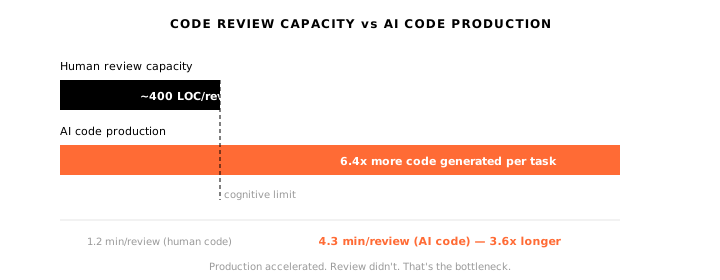
AI can write 1000 lines in seconds. Humans still review at 400 lines/hour max.
This is the real tension. Not that review is suddenly harder—it’s that code production has accelerated while review capacity hasn’t.
The Tool Landscape
Five tools worth knowing:
Devin Review (Cognition)
| Attribute | Value |
|---|---|
| Launch | January 2026 |
| Pricing | Free (beta) |
| Unique feature | Semantic diff organization |
| Strength | Groups changes by logical connection |
| Weakness | Unproven at scale |
CodeRabbit
| Attribute | Value |
|---|---|
| Scale | Claims 2M+ repos, 9K+ orgs |
| Pricing | Free (public repos), Pro available |
| Unique feature | 40+ linters under the hood |
| Strength | Most adopted, rich features |
| Weakness | Accuracy concerns on complex code |
PR-Agent (Qodo)
| Attribute | Value |
|---|---|
| Pricing | Open source (Apache 2.0) |
| Unique feature | Multi-model, multi-platform |
| Strength | Control, no lock-in, fast (~30s/call) |
| Weakness | DIY setup required |
GitHub Copilot Code Review
| Attribute | Value |
|---|---|
| Pricing | Premium (Copilot Pro/Business) |
| Unique feature | Native GitHub integration |
| Strength | Will never approve PRs (by design) |
| Weakness | GitHub-only |
Sourcery
| Attribute | Value |
|---|---|
| Pricing | Free-$12/month |
| Unique feature | IDE-first, refactoring focus |
| Strength | Real-time suggestions |
| Weakness | Less bug detection |
Tool Comparison
| Dimension | Devin | CodeRabbit | PR-Agent | Copilot | Sourcery |
|---|---|---|---|---|---|
| Open Source | No | No | Yes | No | Partial |
| GitLab | No | Yes | Yes | No | Yes |
| Semantic Diff | Yes | No | No | No | No |
| Best For | Early adopters | General use | Control/DIY | GitHub shops | Refactoring |
The Hidden Risk: Automation Bias
This is the most important finding.
| Finding | Source | Confidence |
|---|---|---|
| Developers accept AI suggestions without full review | Stanford/NYU Study 2023 | High |
| Users of AI assistants produced less secure code | Stanford Study 2022 | High |
| Over-reliance on AI increases with perceived accuracy | Human Factors research | High |
The danger: AI code review could make things worse if humans rubber-stamp AI output the same way they rubber-stamp human output.
GitHub’s design choice is telling: Copilot explicitly will not approve PRs. This is intentional—they know the risk.
Real-World Stories
The Copilot Vulnerability Study (2022)
Stanford researchers found that developers using GitHub Copilot produced less secure code than those without AI assistance. The study across 47 participants showed AI-assisted developers were more likely to introduce vulnerabilities while believing their code was more secure.
Google’s Code Review Research (2018)
Google published “Modern Code Review: A Case Study at Google” showing that even at Google, with sophisticated tooling, code review effectiveness varies significantly by reviewer experience and review size. They found that smaller changes get more thorough reviews.
The SmartBear 10-Year Study
SmartBear’s analysis of 10 years of code review data across multiple organizations found consistent patterns: review effectiveness drops dramatically after 400 LOC, and reviewers miss more defects under time pressure—regardless of tooling.
The “AI Code Review Bubble” (2026)
Greptile’s co-founder Daksh Gupta argues the AI code review space is overcrowded—the “hard seltzer era” of AI tooling. His contrarian take: the same AI shouldn’t write and review code. “An auditor doesn’t prepare the books, a fox doesn’t guard the henhouse, and a student doesn’t grade their own essays.”
He pushes further: code review should become fully autonomous since it requires “little in the way of creative expression” and produces objectively measurable outcomes. This is the most aggressive position in the space—removing humans from the review loop entirely.
Notable: No performance data provided, purely philosophical differentiation.
What Could Go Wrong
| Risk | Likelihood | Impact |
|---|---|---|
| Automation Bias | High | High |
| False Sense of Security | High | High |
| Rubber-Stamping AI Output | High | High |
| Security Vulnerabilities Missed | Medium | Critical |
| Alert Fatigue (too many false positives) | High | Medium |
Recommendations
For Teams Evaluating Tools
- Start with PR-Agent if you want control and cost efficiency
- Use CodeRabbit if you want a managed solution at scale
- Stick with Copilot if you’re all-in on GitHub
- Watch Devin Review if semantic diff matters to you
For Teams Adopting AI Review
- Never let AI be the only reviewer — require human sign-off
- Measure defect escape rate — the only metric that matters
- Tune aggressively — false positives kill adoption
- Train for automation bias — awareness is mitigation
- Review security separately — don’t trust AI for security
For Process Design
- Keep PRs small — 200-400 LOC optimal
- Review slowly — under 500 LOC/hour for quality
- Use AI for first pass — let humans focus on architecture/logic
- Track substantive comments — not just approvals
What NOT to Optimize
| Anti-Metric | Why Dangerous |
|---|---|
| Reviews per day | Incentivizes rubber-stamping |
| Lines reviewed per hour | Speed over quality |
| AI approval rate | Over-reliance on AI |
| Time to merge | Sacrifices quality for speed |
Confidence Assessment
| Claim | Confidence |
|---|---|
| Review is a bottleneck | High |
| Review is THE bottleneck | Low |
| AI tools help with review | Medium |
| AI accuracy claims are verified | Low |
| Automation bias is a real risk | High |
Sources & Provenance
Verifiable sources. Dates matter. Credibility assessed.
Modern Code Review: A Case Study at Google ↗
Sadowski, Söderberg, Church, Sipko, Bacchelli · ACM ICSE 2018
"Code review at Google catches design issues, maintains code quality, and facilitates knowledge transfer. Smaller changes receive more thorough review."
Do Users Write More Insecure Code with AI Assistants? ↗
Perry, Srivastava, Kumar, Boneh · Stanford University
"Participants with access to AI assistant wrote significantly less secure code than those without, yet believed their code was more secure."
Expectation vs. Experience: Evaluating the Usability of Code Generation Tools ↗
Vaithilingam, Zhang, Glassman · ACM CHI 2023
"Users often accept AI-generated code without thorough verification, especially when under time pressure."
IEEE Standard for Software Reviews and Audits ↗
IEEE · IEEE Standards
"Recommended inspection rate: 150 lines of code per hour for thorough technical review."
Best Practices for Code Review ↗
SmartBear · SmartBear Learn
"Review no more than 200-400 lines of code at a time. Defect detection rate drops significantly beyond this threshold."
The Octoverse 2024: AI in Software Development ↗
GitHub · GitHub Blog
"97% of developers have used AI coding tools. Adoption is near-universal in professional development."
GitHub Copilot Code Review Documentation ↗
GitHub · GitHub Docs
"Copilot reviews leave 'Comment' status, never 'Approve' or 'Request changes' - explicitly designed to require human approval."
PR-Agent: AI-Powered Code Review ↗
Qodo (formerly CodiumAI) · GitHub
"Open source, Apache 2.0 license. Supports multiple LLMs and platforms. ~30 seconds per tool call."
CodeRabbit - AI Code Reviews ↗
CodeRabbit · CodeRabbit Website
"Claims 2M+ repositories, 9K+ organizations. Integrates 40+ static analysis tools with LLM layer."
Devin Review Launch Announcement ↗
Cognition Labs · Cognition Blog
"Claims code review is now the bottleneck in AI-assisted development. Introduces semantic diff organization."
There is an AI Code Review Bubble ↗
Daksh Gupta · Greptile Blog
"The same AI shouldn't write and review code. Code review should become fully autonomous—humans out of the loop entirely."