Your AI Agent Has Hands Now
AI went from suggesting code to running your terminal. Here's what that means for how you work — backed by data.
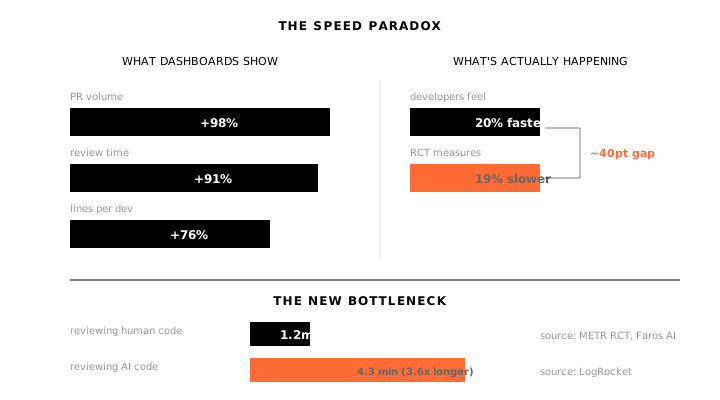
AI coding agents now read files, run commands, and spawn sub-agents autonomously. PR volume up 98%, review time up 91% (Faros AI, 10K+ devs). Developers feel 20% faster but measure 19% slower (METR RCT). The bottleneck moved from writing code to reviewing it.
Five Years, Four Phases
In 2021, Copilot suggested the next line. You pressed Tab.
In 2023, Cursor read your files and edited them. You approved.
In 2025, Claude Code ran your tests, searched your codebase, and spawned sub-agents. You watched.
In 2026, agents get assigned GitHub issues, write PRs, and review each other’s work. You orchestrate.
This is called “programmatic tool calling.” The AI doesn’t just generate text — it takes action. It reads your files, runs your tests, executes bash commands, searches the web, and manages sub-agents with fresh context windows.
What The Agent Can Do Now
Claude Code’s tool suite, for example:
The agent doesn’t need you to find the file. It uses Glob and Grep to locate it. It doesn’t need you to run the tests. It uses Bash. It doesn’t need you to explore the codebase. It spawns an Explore sub-agent with read-only access.
The Uncomfortable Data
The numbers don’t tell a simple story.
The volume and review numbers come from Faros AI (10,000+ developers). The speed measurement comes from the most rigorous study to date — a randomized controlled trial by METR. 16 experienced open-source developers, their own repositories (22K+ stars, 1M+ lines), randomly assigned to use or not use AI tools.
Result: developers using AI were 19% slower. While believing they were 20% faster.
The gap is almost 40 percentage points.
Why? Developers accepted less than 44% of AI generations. The overhead of reviewing, testing, and rejecting bad suggestions ate the productivity gains. On large, complex, mature codebases, the AI’s confidence outran its accuracy.
The New Bottleneck
Code generation got dramatically faster. Code review didn’t.
The review data comes from LogRocket. Cursor spent $290M+ acquiring Graphite (December 2025) specifically because of this. Their CEO: “code review is taking a growing share of developer time as the time spent writing code keeps shrinking.”
The review shifted from “does this work?” to “do we need all of this?”
What Actually Changed About Your Job
Three concrete shifts:
1. You’re a reviewer now. The primary skill isn’t writing code. It’s reading AI-generated code critically. Spotting the over-engineering. Catching the subtle bugs. Deciding what’s necessary.
2. You write specs, not code. 15-minute “rapid waterfall” spec sessions before implementation. Break work into micro-tasks. The spec is the artifact — the code is generated from it.
3. You configure agents. 67% of repos now have CLAUDE.md files. This is a new developer artifact: instructions written by humans for consumption by AI, checked into version control. Your implicit conventions now need to be explicit.
The Trust Question
Trust isn’t binary. It’s learned through experience — understanding when the agent is right, when it’s confidently wrong, and when to intervene. The auto-approve data is from Anthropic’s agent autonomy research. The calibration estimate is from a UC San Diego / Cornell study — a full year of daily use.
The Skill That Matters Now
The agent has hands. You have the brain. The question is whether you can review what those hands produce — faster than the agent can produce it.
That’s not a rhetorical question. At 4.3 minutes per AI review vs 1.2 minutes for human code, and 6.4x more code generated, the math says most teams can’t. Not yet.
Where Sessions Come In
A single Claude Code session can produce 50-200+ tool calls. Each one is a decision — which file to read, which command to run, which approach to try and reject.
When sessions vanish, all of that vanishes. The METR study found developers rejected 56% of AI generations. That’s 56% of the agent’s exploration — dead ends, wrong turns, approaches that didn’t work — lost. Next time the same bug surfaces, the agent re-explores from zero.
Session memory turns rejected approaches into “don’t try this again” signals. It turns successful debug traces into “start here next time.” The more autonomous the agent, the more valuable it becomes to persist what it did and why.
For the full research behind this post — 14 sources, confidence assessments, and recommendations — see the Programmatic Tool Calling library report.